The extrusion process is a critical step in candy forming, and its precision directly impacts the final product's shaping, appearance, and texture. During the extrusion of candy ropes, you may occasionally notice intermittent feeding or even direct breakage. This not only causes raw material waste but also compromises the efficiency and aesthetic quality of subsequent forming stages. In many cases, the root cause of this material breakage lies in inadequate temperature control within the machine.
Candy raw materials are highly sensitive to temperature fluctuations. Traditional single-tank or basic heating systems typically only provide overall or rough heating for the extruder, resulting in an objective flaw: uneven sizing of the extruded candy ropes.
As the candy mass flows through the barrel, localized low temperatures can cause the mass to harden and its flowability to drop, thereby increasing extrusion resistance and potentially leading to machine jamming or motor burnout. Conversely, localized high temperatures may alter the properties of the mass, triggering coking. This uneven temperature distribution prevents the formation of continuous, smooth ropes during extrusion, making it difficult to guarantee consistent material output.
To address the aforementioned issues, candy extruders incorporate a zoned temperature control system. Simply put, this divides the extruder into separate, independently controlled temperature zones.
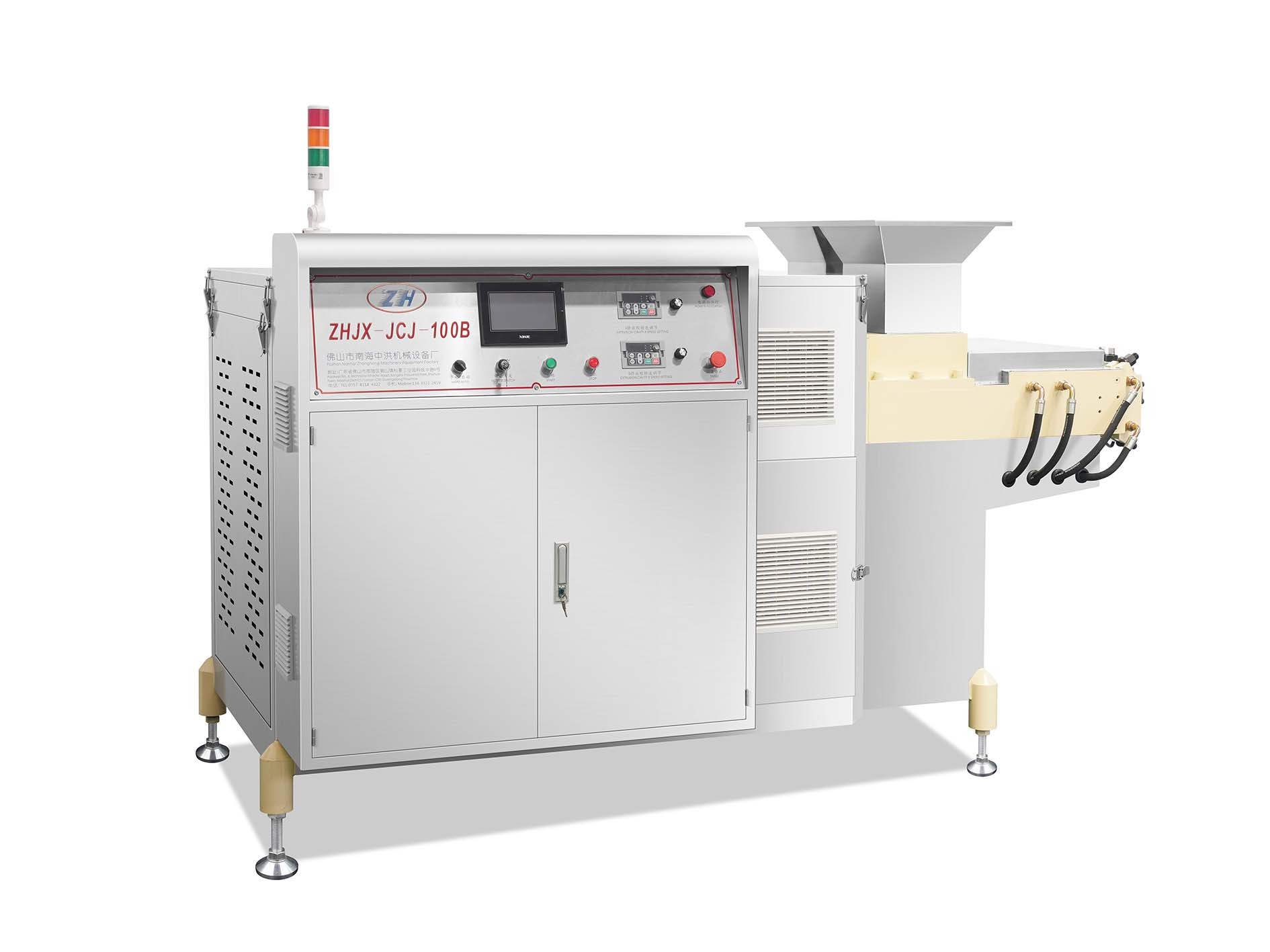
The core independent temperature control system typically consists of three sections: the upper chamber, the lower chamber, and the die head.
By dividing the extruder into these three independent zones, each section can be equipped with its own temperature sensor and a dedicated heating/cooling unit. This allows operators to set the optimal temperature for each specific area based on the unique characteristics of the candy mass.
Three independent circulating temperature control systems serve as the hardware foundation of this concept. Equipped with three separate heating circuits at 6kW each, the system provides precise temperature control for the upper extrusion chamber, the lower extrusion chamber, and the die head, creating a highly accurate thermal balance system.
The PLC system automatically controls heating or initiates cooling programs based on real-time temperature feedback to maintain stable water temperatures in each zone. Under this precise control, the candy mass maintains its ideal state and viscosity from the extrusion chamber to the die head. Consequently, the mass flows continuously, stably, and evenly through the die holes, significantly reducing the occurrence of material breakage, streaks, and air bubbles.
The transition from basic heating to 3-zone independent temperature control reflects the evolution of candy manufacturing from fundamental to precision engineering. Only by mastering the science of temperature can manufacturers produce premium candies with flawless appearances and consistent textures.
If you are seeking extrusion equipment that offers precise temperature control to elevate your candy quality, consider Zhonghong Machinery's Candy Extruders. We are committed to providing more scientific and stable temperature control technologies to help reduce material waste on your production line, ensuring every single candy achieves its ideal state.
